

Real Estate Rendering for Developers
Broker Campaigns Sales Visuals | ArchVant
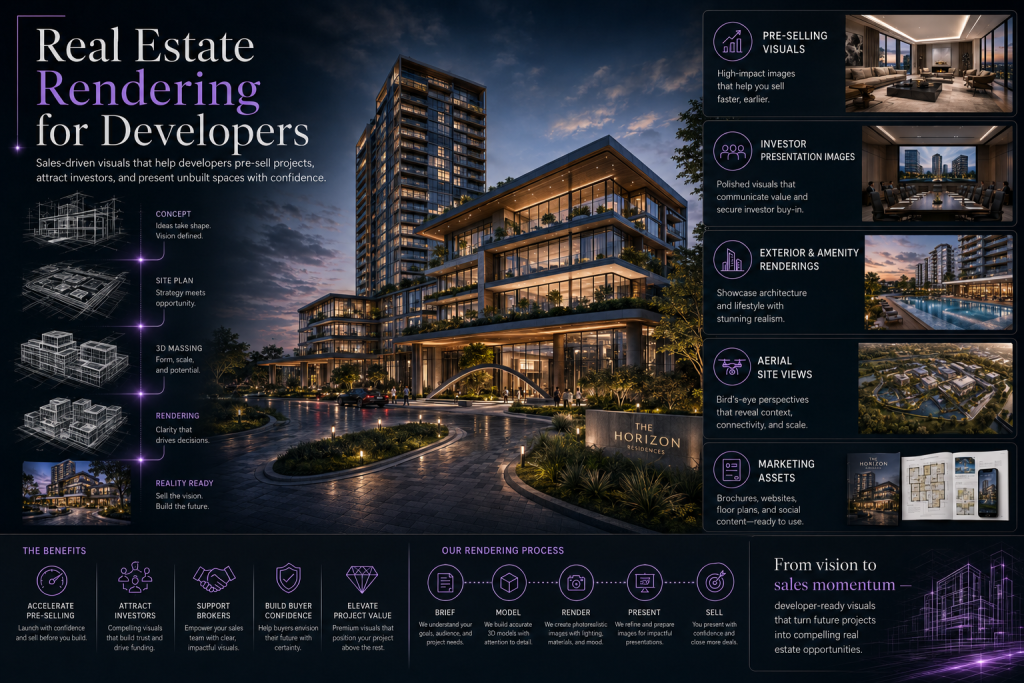
Real Estate Rendering for Developers for Broker Campaigns
ArchVant helps developers sell the future with visual assets designed for launches, brokers, investors, and buyers. Built for broker campaigns, this landing page focuses on visuals that help teams win bigger deals before construction begins.
Real Estate Rendering for Developers: How Visuals Help Sell Projects Before Construction Begins
SEO Title: Real Estate Rendering for Developers | Pre-Selling, Marketing, and Investor Visuals
Meta Description: Real estate rendering for developers helps present unbuilt projects with photorealistic visuals for pre-selling, investor presentations, marketing campaigns, sales galleries, and project launches.
Suggested URL Slug: /real-estate-rendering-for-developers/
Real Estate Rendering for Developers Who Need to Sell the Vision Early
In real estate development, the project often needs to be marketed, presented, funded, and sold before it is fully built. Buyers cannot walk through the finished lobby yet. Investors cannot see the completed tower. Brokers cannot physically show the amenities, views, landscaping, or lifestyle experience.
This is where real estate rendering for developers becomes essential.
Real estate rendering transforms architectural plans, sketches, CAD drawings, and design concepts into photorealistic visuals that show the future project clearly. These images help developers communicate the value of a property before construction is complete.
For condominium towers, subdivisions, resorts, mixed-use developments, commercial buildings, townships, and luxury residential projects, high-quality renderings can make the difference between a project that looks ordinary and a project that feels desirable, credible, and ready for the market.
What Is Real Estate Rendering?
Real estate rendering is the creation of realistic 3D images for property developments that are not yet built or not yet finished. These visuals are used for marketing, sales, investor communication, planning approval, and project presentation.
A real estate rendering can show:
- Building exteriors
- Lobby and amenity interiors
- Residential units
- Pool decks and gardens
- Retail podiums
- Clubhouses
- Streetscapes
- Aerial site views
- Masterplanned communities
- Mixed-use developments
- Resort environments
- Commercial spaces
- Sales and marketing visuals
The goal is not only to show the architecture. The goal is to make the project easy to understand, attractive to buyers, and convincing to investors.
A strong rendering helps answer one important question:
Why should someone buy, invest, approve, or believe in this project now?
Why Developers Need Real Estate Renderings
Developers operate in a competitive market. A buyer may be comparing several condominium projects. An investor may be looking at different development opportunities. A broker may need strong materials to explain the project quickly. A government or planning body may need to understand the impact of the development.
Technical drawings are not enough for these audiences.
Most people respond faster to visuals than to floor plans, elevations, and technical documents. They want to see the finished experience.
Real estate renderings help developers show:
- The lifestyle being offered
- The quality of the architecture
- The feeling of the interiors
- The scale of the development
- The value of the location
- The mood of the amenities
- The identity of the project brand
- The long-term development vision
When the future becomes visible, the project becomes easier to sell.
Real Estate Rendering for Pre-Selling
Pre-selling is one of the biggest reasons developers need professional renderings.
Many real estate projects are sold while still under construction or even before construction begins. This means the sales team must sell a future promise. Without strong visuals, that promise can feel abstract.
Renderings make the future feel real.
A pre-selling campaign can use renderings to show the buyer what they are investing in:
- The tower exterior
- The entrance lobby
- The amenity floor
- The swimming pool
- The gym
- The lounge
- The unit interior
- The balcony view
- The surrounding neighborhood
- The lifestyle experience
This gives buyers more confidence. It also gives brokers stronger sales materials.
Instead of asking buyers to imagine the project, developers can show them a visual story that feels complete, premium, and believable.
Real Estate Rendering for Investor Presentations
Investors need numbers, but they also need clarity. They want to understand what the development will become, who it will serve, and why it has market potential.
A strong real estate rendering can support the investment story.
It can show the quality of the project, the scale of the opportunity, the target market, and the final vision. When combined with financial projections, location analysis, market positioning, and development strategy, renderings make an investor presentation more persuasive.
Renderings are useful for:
- Investor pitch decks
- Joint venture proposals
- Landowner presentations
- Bank financing presentations
- Private equity discussions
- Public-private partnership proposals
- Strategic partner meetings
- Development launch presentations
Investors do not want confusion. They want confidence.
Clear visuals help create that confidence.
Real Estate Rendering for Marketing Campaigns
A real estate project needs strong marketing assets before launch. Developers need visuals for websites, social media, brochures, billboards, presentations, email campaigns, and sales galleries.
Professional renderings can be used across many marketing materials:
- Website hero images
- Landing page banners
- Facebook and Instagram ads
- YouTube thumbnails
- Brochures and flyers
- Sales office displays
- Outdoor advertising
- Property portal listings
- Investor decks
- Email campaigns
- Launch event presentations
A good rendering is not just an image. It becomes a repeatable marketing asset.
For developers, this matters because visual consistency builds trust. When the project looks premium across all materials, the market perception becomes stronger.
Types of Real Estate Renderings Developers Should Use
1. Exterior Building Renderings
Exterior renderings are usually the first visual impression of the project. They show the architectural character, façade, materials, entrance, landscaping, lighting, and overall identity of the development.
For high-rise residential projects, exterior renderings help communicate scale and prestige. For luxury villas, they show privacy and lifestyle. For commercial buildings, they show professionalism and business value.
A strong exterior rendering should make the project instantly understandable and attractive.
2. Interior Unit Renderings
Interior unit renderings are important because buyers want to imagine themselves living in the space. Even a compact unit can feel valuable when presented properly with good lighting, furniture, finishes, and composition.
Interior renderings can show:
- Living areas
- Bedrooms
- Kitchens
- Bathrooms
- Dining areas
- Home office corners
- Balcony views
- Premium finishes
For condominiums and residential projects, unit renderings help buyers emotionally connect with the property.
3. Lobby and Amenity Renderings
The lobby and amenities often influence perceived value. Buyers want to see more than the unit. They want to know what kind of lifestyle the development offers.
Amenity renderings may include:
- Grand lobby
- Swimming pool
- Fitness center
- Lounge
- Co-working area
- Function room
- Children’s play area
- Sky deck
- Garden terrace
- Retail podium
- Reception area
These visuals help position the development as more than a building. They make it feel like a lifestyle destination.
4. Aerial Real Estate Renderings
Aerial renderings are useful for showing the full development and its site context. They help viewers understand the project’s relationship to roads, nearby landmarks, commercial areas, transport access, green spaces, and surrounding developments.
Aerial views are especially powerful for:
- Mixed-use developments
- Townships
- Masterplanned communities
- Waterfront projects
- Industrial parks
- Resort developments
- Large residential estates
- Transit-oriented developments
For investors and planners, aerial renderings make the scale and logic of a development easier to understand.
5. Streetscape and Lifestyle Renderings
Real estate is not only about buildings. It is about how people experience a place.
Streetscape renderings show sidewalks, cafés, retail frontage, landscaping, pedestrians, vehicles, lighting, signage, and public spaces. These visuals are useful for mixed-use developments, commercial districts, retail centers, and urban residential projects.
Lifestyle renderings help buyers imagine daily life inside the project.
They can show:
- Families walking through landscaped gardens
- Professionals entering the lobby
- Residents relaxing by the pool
- Shoppers visiting retail areas
- Guests arriving at a hotel or resort
- People enjoying rooftop amenities
These images create emotional connection.
6. Masterplan and Township Renderings
For large-scale developments, one building image is not enough. Developers need to show the full vision.
Masterplan renderings help explain:
- Land use
- Road networks
- Building placement
- Parks and open spaces
- Commercial areas
- Residential zones
- Institutional areas
- Transport links
- Phasing strategy
- Long-term development potential
This is ideal for townships, smart cities, mixed-use districts, waterfront communities, resort estates, and industrial developments.
A masterplan rendering helps stakeholders see the bigger opportunity.
What Makes a Real Estate Rendering Effective?
A real estate rendering must be beautiful, but beauty alone is not enough. It must support sales, branding, and decision-making.
An effective real estate rendering should be:
Clear — The viewer should immediately understand what is being shown.
Realistic — Materials, lighting, scale, and details should feel believable.
Aspirational — The image should create desire and emotional interest.
Market-aligned — The style should match the target buyer or investor.
Brand-consistent — The image should support the project’s identity.
Commercial-ready — It should be usable for ads, brochures, websites, and presentations.
For luxury buyers, the rendering should feel premium and refined. For investors, it should feel credible and organized. For families, it should feel safe, comfortable, and livable. For commercial tenants, it should feel active and professional.
The visual strategy must match the market.
How Real Estate Renderings Help Brokers Sell
Brokers need simple, strong materials to explain a project quickly. A buyer may not have time to read long documents, but a strong image can communicate value in seconds.
Renderings help brokers present:
- What the project will look like
- What the amenities will offer
- What kind of lifestyle buyers can expect
- Why the location matters
- Why the project feels premium
- Why the buyer should act early
This makes the sales conversation more visual and persuasive.
A rendering also gives brokers content for social media, chat messages, email follow-ups, and client presentations.
For developers working with broker networks, strong visuals can help increase project confidence and selling energy.
Real Estate Rendering and Buyer Psychology
People buy real estate with both logic and emotion.
Logic includes price, location, payment terms, floor area, developer reputation, and investment potential. Emotion includes lifestyle, comfort, status, beauty, security, and the feeling of ownership.
Renderings help connect both sides.
They make the project look real enough for logical evaluation and attractive enough for emotional desire.
A buyer may ask:
Can I see myself living here?
Will this property impress my family?
Does this project feel premium?
Will this be a good investment?
Does the development match my lifestyle?
Good renderings help answer these questions visually.
Real Estate Rendering for Different Project Types
Condominium Developments
Condo renderings should show exterior towers, lobby interiors, amenity decks, unit interiors, views, podium areas, and lifestyle scenes.
Luxury Residential Projects
Luxury home renderings should focus on privacy, materials, landscaping, lighting, pools, interiors, and emotional atmosphere.
Mixed-Use Developments
Mixed-use renderings should show the relationship between residential, retail, office, public space, and pedestrian activity.
Resorts and Hospitality Projects
Resort renderings should highlight arrival experience, pools, villas, restaurants, beachfront areas, gardens, and premium guest atmosphere.
Commercial Buildings
Commercial renderings should show professionalism, accessibility, tenant appeal, activity, and business credibility.
Townships and Masterplanned Communities
Township renderings should show scale, road networks, lifestyle zones, parks, schools, commercial areas, and long-term growth.
What Developers Should Prepare Before Starting
A developer does not always need complete construction documents to start real estate rendering. Early-stage visuals can be created from concept materials, while detailed renderings require more complete design files.
Useful materials include:
- Site plan
- Floor plans
- Elevations
- CAD files
- 3D model, if available
- Material references
- Landscape references
- Interior design direction
- Branding guidelines
- Target buyer profile
- Project location details
- Preferred mood and image style
- Marketing use case
The clearer the brief, the stronger the final visual direction.
Developers should also define the purpose of each rendering. A visual for investor presentation may need a different approach from a visual for social media advertising.
Common Mistakes Developers Should Avoid
One mistake is treating renderings as an afterthought. If the visuals are weak, inconsistent, or rushed, the project can look less valuable than it really is.
Another mistake is creating images without a clear target market. A luxury development, family-friendly condo, commercial project, and investor-focused masterplan should not all look the same.
Developers should avoid:
- Low-quality lighting
- Unrealistic materials
- Empty scenes with no life
- Confusing camera angles
- Overcrowded compositions
- Generic furniture and landscaping
- Inconsistent branding
- Renderings that do not match the sales message
A rendering should help the project sell. If it does not support the business goal, it is not doing its job.
Why Work With ArchVant
ArchVant creates real estate renderings for developers who need visuals that support sales, marketing, funding, and project presentation.
The focus is not only on producing attractive images. The focus is on creating developer-ready visuals that make projects easier to understand, easier to believe, and easier to sell.
ArchVant provides rendering services for:
- Condominium towers
- Luxury residences
- Mixed-use developments
- Resorts and hotels
- Commercial buildings
- Townships
- Masterplanned communities
- Infrastructure projects
- Smart city concepts
- Investor presentations
Every project is approached with the target market in mind. The goal is to create visuals that match the buyer profile, project positioning, and development strategy.
Final Thoughts
Real estate rendering is one of the strongest tools a developer can use before construction is complete. It helps turn plans into desire, concepts into confidence, and future spaces into marketable assets.
For developers, good renderings can support pre-selling, investor discussions, broker presentations, project launches, and long-term brand positioning.
The real estate market rewards projects that are communicated clearly.
A strong development deserves visuals that make the market believe in it.
Call to Action
Ready to present your project with stronger sales visuals?
Start your real estate rendering project with ArchVant today.
CTA: Request Real Estate Renderings